

Driving a Large-Scale Call Center Platform Upgrade with Agile Delivery and On-Time Execution
Our team modernized a call center application that had been in use for over 20 years, and delivered it on time using Agile Scrum.
Overview
Legacy enterprise applications often become a bottleneck as a business grows. When they are built on outdated architectures or tightly coupled technologies, they struggle to meet modern needs for scalability, integration, and performance.
Around 70% of IT budgets go towards maintaining legacy systems, and this ongoing maintenance rarely delivers new business value. That’s why 87% of business leaders believe that application modernization is essential to grow and succeed.
One of our clients, a leading investment management organization, had a large call center desktop application that needed to be upgraded. So, the client worked with the DivIniSoft team on the system conversion. Let’s see how we helped the client modernize the application and reduce its running costs.
Challenges
The client’s call center operations played a critical role in handling investor inquiries, account management, and time-sensitive financial interactions. The existing desktop application had been in use for over 20 years by many users across different locations, and it was deeply embedded in daily work. This made it difficult to modify, scale, or replace without disrupting the business.
However, over time, the legacy application started to introduce operational risks and increase maintenance costs. For example:
- The outdated software was more open to cyber-attacks, because it did not have up-to-date security measures against newer threats.
- The application was slow compared to the growing call volumes and expanding investor services, and without upgrades it would only get slower.
- The older system did not integrate well with the client’s newer systems.
- It was difficult to find specialists in the outdated technology behind the application.
So, the senior manager in charge decided to modernize the application. It was the only option that would be comprehensive, easy to customize, and less expensive to maintain in the long term.

Our Strategy
Our team of IT experts and consultants analyzed the existing application and presented the client with a clear, strategic modernization plan. It included a detailed roadmap for moving to a Java-based web application, an optimal team structure to improve efficiency, and cost estimates for both the immediate and the long-term goals.
Our Implementation
The plan was carried out in three phases, based on our analysis of the client’s current setup. Here’s how we executed the modernization.
-
01
Architecture Setup and Legacy Decoupling
Based on the approved roadmap, the team designed the target platform architecture and set up the core application framework. We analyzed the legacy components at code level to find tightly coupled modules, dependencies, and integration points. Then we introduced interfaces to decouple the legacy logic, so new development could run in parallel without disrupting current operations.
-
02
Incremental Migration and Feature Modernization
The team modernized the application in iterations, using Agile Scrum with 2-week sprints. High-impact modules such as call handling, investor data access, and transaction workflows were re-engineered and migrated to the new platform. We introduced APIs for data exchange with the client’s newer enterprise systems, which improved interoperability and reduced the reliance on legacy applications. At the end of each sprint, our team gave a demo to the client and worked their feedback into the next iteration.
-
03
System Integration, Performance Optimization, and Rollout
In the final phase, the modernized components were fully integrated with downstream systems, including the CRM, data, and security platforms. Our testing team ran functional testing, regression testing of the backend APIs using RestClient with Cucumber (BDD), regression testing of the web UI using Selenium with Cucumber (BDD), performance testing, and security testing, to make sure the new application met industry standards. The upgraded call center application was then rolled out to production.
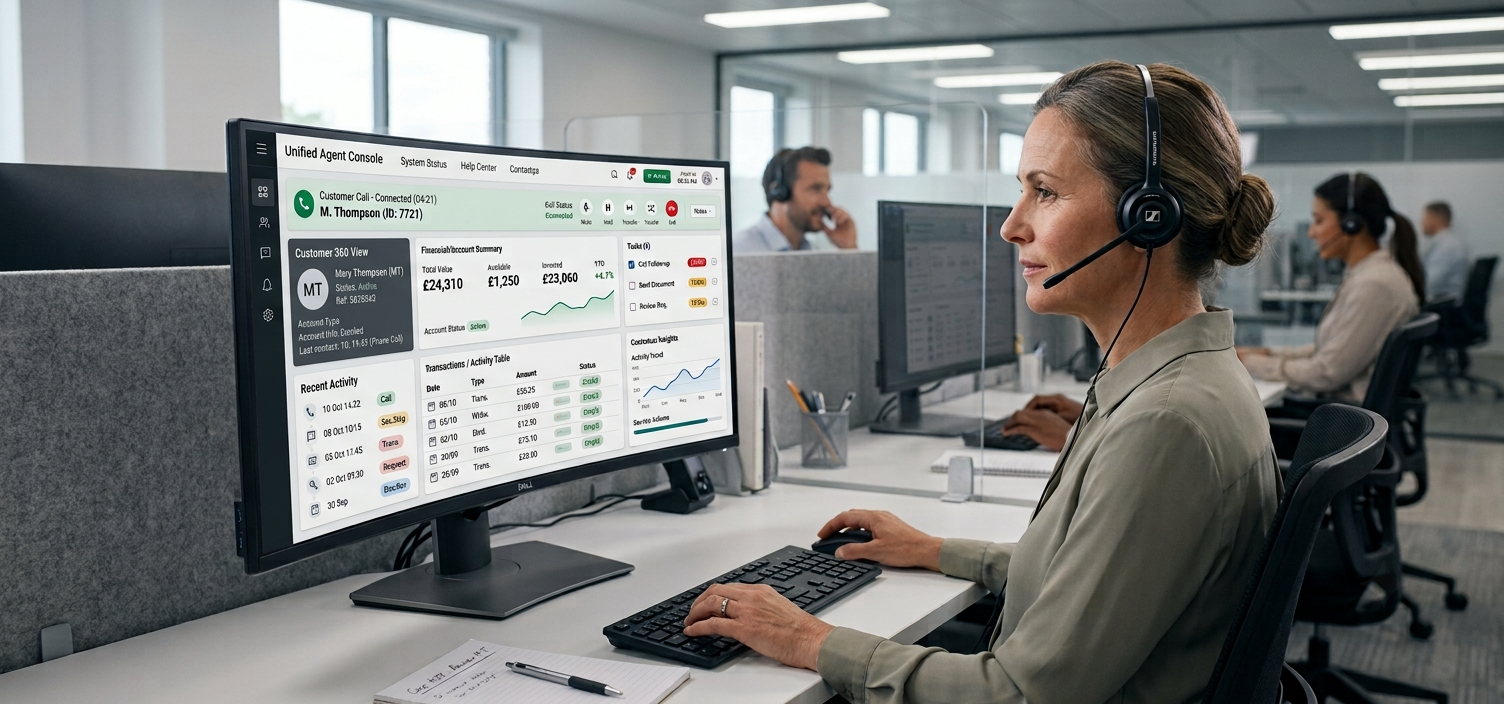
Business Outcomes
- Cut average call handling time by 40%, due to faster workflows and fewer system delays.
- Lowered annual maintenance costs by 50%.
- Reduced operational risks by retiring the old technologies.
- Reduced security and compliance risks through modern security practices.
- Improved system stability, with fewer outages and disruptions.
- Improved agent productivity and streamlined call handling, through faster application response times.
Tech Stack
Conclusion
By modernizing the legacy call center application with a structured, Agile approach, DivIniSoft helped the client reduce operational risk, improve system performance, and prepare the platform for long-term scalability. The entire plan was delivered as per the timeline. Our experience in system conversion and enterprise application modernization meant the move to the new platform went smoothly, without disrupting critical call center operations.