Services · AI Native Product Engineering

AI Native Product Engineering

Every engineering shop claims to “use AI.” The distinction that actually matters: are your developers fluent in AI-native tools as part of how they build every day? Our engineers work this way every day — scaffolding, refactoring, test generation, code review — under the same senior accountability and review discipline we'd apply regardless. Faster iteration without compromising standards.

In the daily build loop
  • Claude Code
  • Codex
  • Cursor
PR #482 · checkout-flow

Refactor checkout to support split payments across two cards.

  • Scaffolded with Claude Code
  • Test coverage: 94%
  • Senior review: approved
Merged — 0 rollbacks

Full Stack Software Development

End-to-end software solutions — database modeling and performance tuning, backend business logic, REST/microservices architecture, and the UI on top — built by one accountable team instead of handed across a frontend team, a backend team, and an integration team who've never spoken. This is where we build the bespoke, mission-critical platforms that off-the-shelf software can't keep up with: systems tailored to how your business actually runs, not how a SaaS vendor assumed it should.

  • Database modeling, schema design and performance tuning
  • Backend business logic and REST/microservices architecture
  • Custom, bespoke platforms built around your workflows, integrations and compliance requirements
  • One team accountable end-to-end — not a relay race across specialist silos
  • Backend depth in Java/Spring Boot, .NET, Python and Scala; PostgreSQL, SQL Server, MongoDB and Redis for data; Kafka for event streaming, on Docker/Kubernetes across AWS and Azure — the same production stack behind our high-volume platforms in health insurance, payments and quant finance
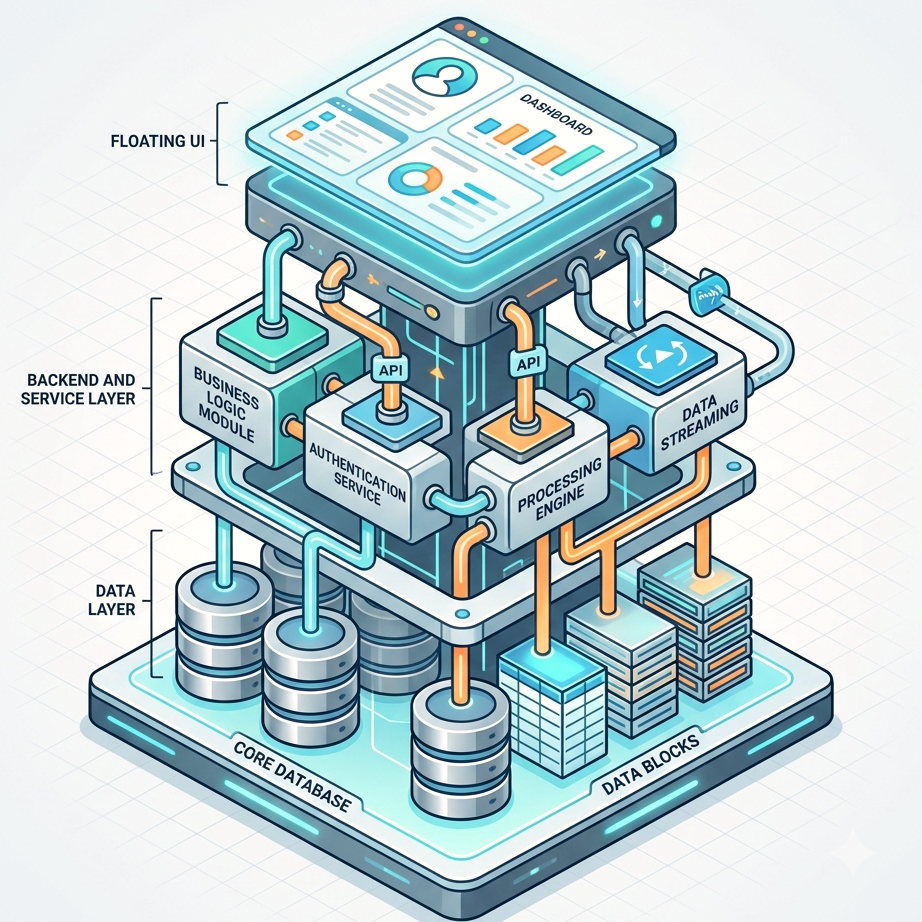
Isometric diagram of a full-stack platform in layers: a floating dashboard UI on top, a backend and service layer of connected modules (business logic, authentication, a processing engine, data streaming) in the middle, and a data layer of databases and data blocks below, wired together end to end

Web Application Development

The web is the least forgiving surface to ship on — every visitor on a different browser, device and connection, and the ones it fails leave without telling you why. So the framework is a deliberate choice, the backend contract is typed so an API change breaks the build and not production, and Core Web Vitals and accessibility run on every pull request — not the week before launch.

  • Framework matched to the work — React and Next.js for product builds, Angular for large teams that need conventions, Vue where yours already runs it
  • Rendering set per route — SSR, static or client-side, chosen for what each page is for; a routing choice in Next.js or Nuxt, not a rebuild
  • A typed contract to the backend — REST or GraphQL with generated types, so a breaking API change is a compile error, not a production incident
  • TanStack Query for server state, a store only where it earns its place, WebSockets or SSE where the data is genuinely live
  • Core Web Vitals, bundle budgets and axe checks as CI gates on every pull request — past budget the build fails; WCAG 2.2 AA verified with Playwright
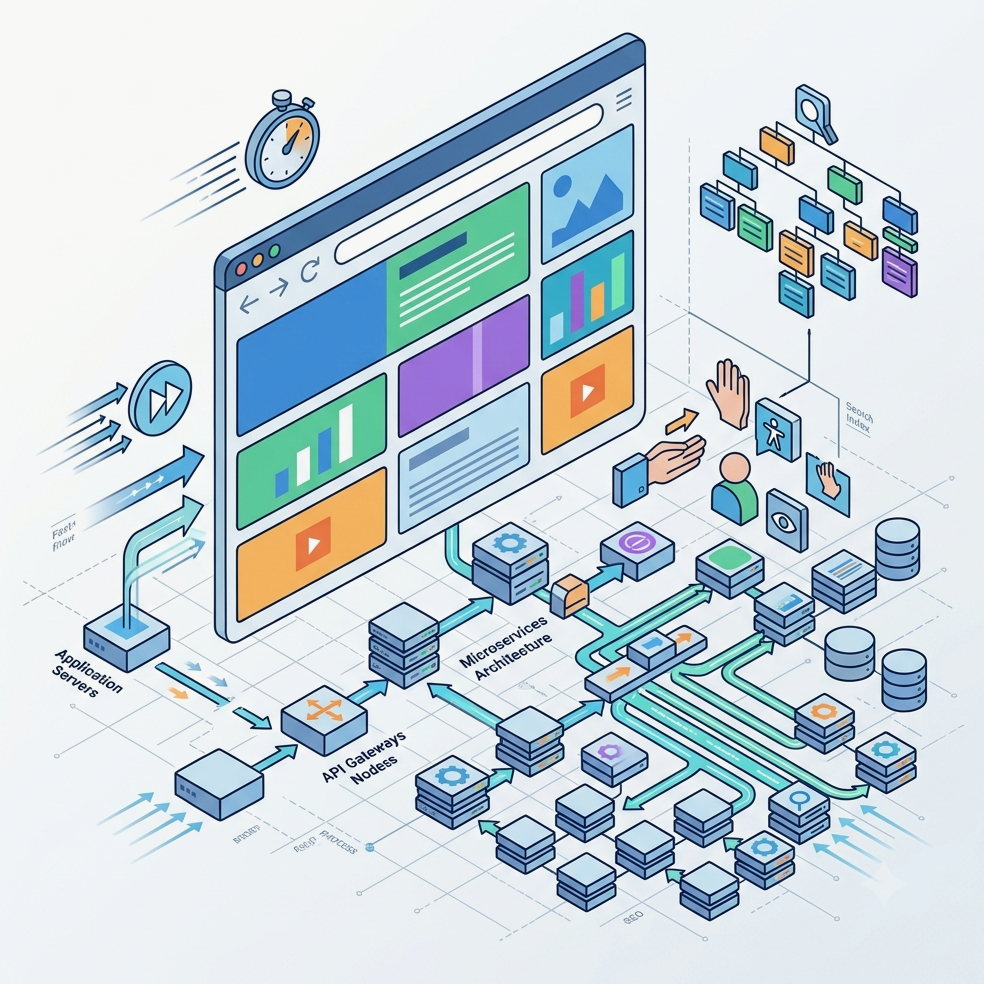
Isometric diagram of a web application: a browser window of content tiles above a fabric of application servers, API gateways and microservice nodes connecting through to databases and a search index

Mobile Applications

Native iOS and Android, and cross-platform where the economics make sense — engineered for the details that separate a professional app from a prototype: smooth 60fps interaction, offline resilience when connectivity drops, and App Store-grade polish through review and beyond.

  • Native iOS/Android and cross-platform (React Native, Flutter) development
  • Offline-first architecture for unreliable connectivity, not just a loading spinner
  • Performance tuned for a consistently smooth frame rate, not just a fast demo
  • App Store and Play Store submission, review, and post-launch support
  • Built for mobile's actual context — GPS, device sensors and IoT connections, cloud sync and analytics wired in, not bolted on after launch
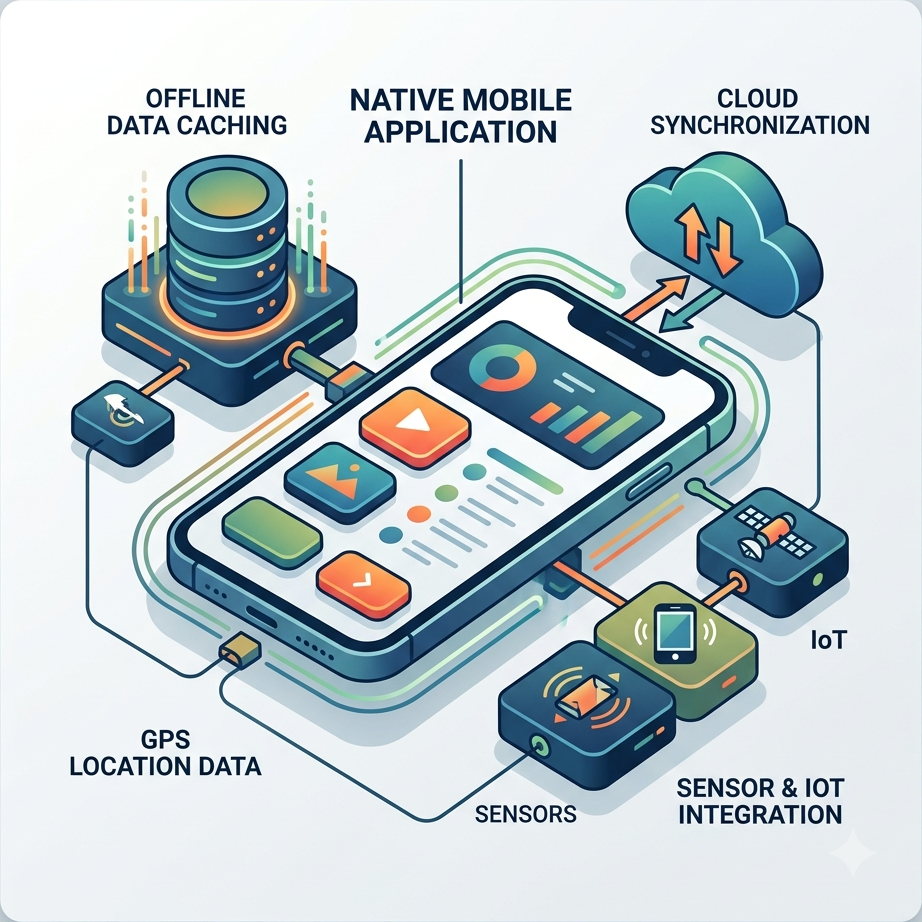
Isometric diagram of a native mobile app: a phone at the centre wired to offline data caching, cloud synchronisation, GPS location, and sensor and IoT device integrations

Desktop Applications

Two desktop platforms, chosen deliberately. Eclipse RCP for the heavyweight, plugin-architecture applications that analysts and engineers keep open all day — a narrowing skill set we have shipped and maintained in production for years, including desktop platforms in quantitative finance. Electron where a tool needs to run on Windows, macOS and Linux from a single codebase. Built by the same full stack team, with the same AI-native development discipline as everything else on this page.

  • Eclipse RCP — modular, plugin-based desktop platforms built on the workspace and perspective model that heavy analytical tools depend on
  • Electron — one codebase across Windows, macOS and Linux, on the same web stack as our full stack work
  • Offline-capable tools for teams that can't depend on a constant connection
  • Internal tooling and specialized workflow applications
  • Auto-update and distribution pipelines built in from day one
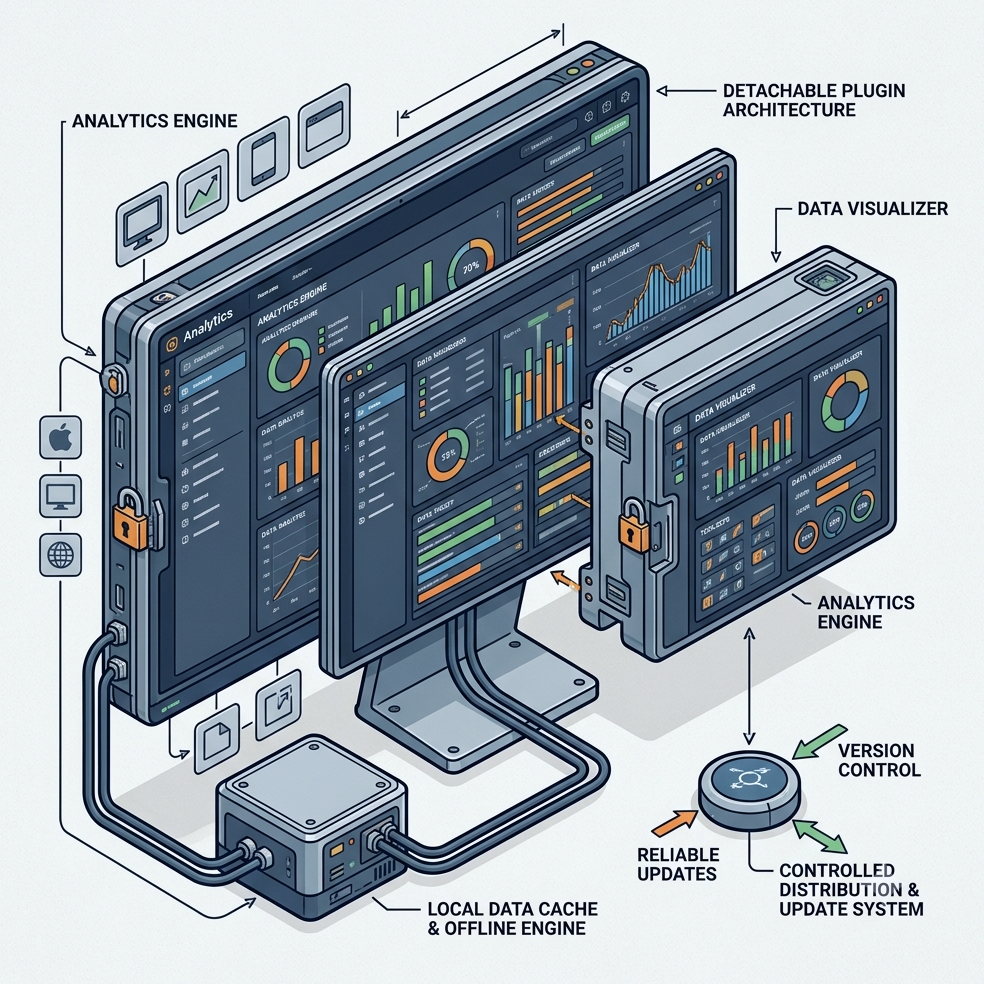
Isometric diagram of desktop applications: analytics and data-visualiser windows built on a detachable plugin architecture, backed by a local offline data cache and a controlled version-control and update distribution system

Let's scope your build

Tell us what you're building — we'll tell you what an AI-native team can actually ship, and by when.